
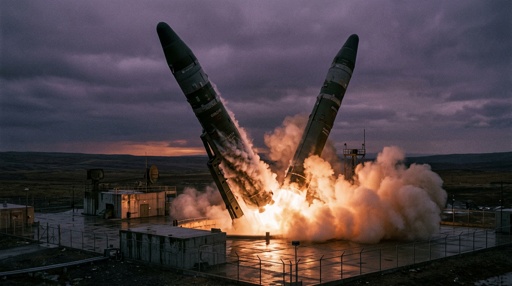
Iran has just tested American resolve with a coordinated missile and drone barrage on U.S. bases across the Middle East, forcing the Trump administration to balance overwhelming military power with keeping our troops alive under constant attack.[2][4]
Story Snapshot
- Iran’s Islamic Revolutionary Guard Corps claimed responsibility for missile and drone strikes on U.S. bases in Kuwait, Qatar, Iraq, and elsewhere, openly framing them as retaliation for prior U.S. actions.[2]
- U.S. and allied officials condemned the attacks as a “dangerous escalation” and “cease-fire violation,” even as American forces relied on air defenses to blunt the barrage.[2]
- Several American troops and contractors were injured by debris at a U.S. base in Kuwait, underscoring the real human cost for U.S. service members.[4]
- The pattern follows earlier cycles where Iran or its forces struck U.S. bases after U.S. operations, creating a repeating loop of strike and counterstrike that leaves American personnel in the crosshairs.[1][2]
Iran Opens a New Front on U.S. Bases
Iran’s latest wave of missile and drone attacks targeted multiple U.S. bases in the region, including key facilities in Kuwait and Qatar that host thousands of American personnel and major command hubs.[2][4] Iran’s Islamic Revolutionary Guard Corps publicly claimed responsibility, describing the strikes as a response to what it calls U.S. “aggression,” reprising language it has used in earlier confrontations.[1][2][3] Reporting on recent crises notes that Iran and Iran-backed forces have launched well over one hundred attacks on U.S. positions since 2023, often calibrated to send a message while testing American defenses.[2]
Kuwaiti authorities confirmed that their air defense systems intercepted incoming missiles and drones, after explosions were heard across the country and residents reported loud blasts near key military zones. Kuwait’s General Staff explicitly linked those explosions to interception of Iranian projectiles aimed at U.S.-linked facilities, signaling how host nations are being dragged deeper into this confrontation simply because they allow American basing. This mirrors earlier episodes where regional partners hosting U.S. forces became immediate targets once Iran chose to escalate.[1][2]
U.S. Forces Under Fire, Defenses Tested Again
According to contemporaneous reporting, several American troops and civilian contractors were injured at a U.S. base in Kuwait after Iranian missiles were intercepted overhead, with debris causing casualties on the ground.[4] Video coverage described five Americans, including uniformed personnel, receiving treatment following the attack, highlighting that even “successful” interceptions carry lethal risk when salvos are aimed at crowded bases.[4] Similar patterns have emerged in recent years, as repeated strikes on U.S. installations in Iraq, Syria, Jordan, and now Kuwait and Qatar have left dozens of Americans wounded.[2]
In Qatar, Iran targeted the Al Udeid Air Base, the largest American installation in the Middle East and a forward headquarters for United States Central Command, with at least one ballistic missile launched directly from Iranian territory.[2][4] A United States defense official confirmed the missile’s origin, and coverage emphasized that this was a direct state-on-state attack, not merely a proxy militia action.[2] Earlier reporting during the current regional crisis already documented an Iranian missile strike on Al Udeid in 2025 after U.S. strikes on Iranian nuclear facilities, showing that Tehran now treats these bases as legitimate repeat targets.[2]
Retaliation Narrative Versus Escalation Reality
Iran’s leadership is again framing the barrage as “retaliation” and “self-defense,” echoing language used during the 2020 Operation Martyr Soleimani, when the Islamic Revolutionary Guard Corps launched more than a dozen ballistic missiles at U.S.-hosted bases in Iraq after the killing of General Qasem Soleimani.[1][3] In that earlier case, Iran told the United Nations the strikes were a “measured and proportionate” act of self-defense, even though United States officials assessed the missiles were intended to kill Americans and cause major damage.[1] The same justification pattern now reappears: Tehran cites prior U.S. strikes on its territory while it hurls missiles at American personnel in third countries.[1][2]
U.S. and allied officials, by contrast, are labeling the latest missile launches as a dangerous violation of cease-fire understandings and a clear escalation that threatens regional stability.[2] Reporting describes United States Central Command accusing Iran of an “egregious cease-fire violation” in a recent Kuwaiti strike episode, while Kuwait’s Foreign Ministry condemned the launches as a “dangerous escalation,” emphasizing the risk to civilians and critical infrastructure.[2] This clash of narratives—Tehran’s retaliation claim versus Washington’s escalation framing—fits a well-documented pattern where each side points to the other as the aggressor, leaving American troops to absorb the consequences on the ground.[2]
A Long Pattern of Targeting American Bases
Compiled chronologies of the Middle Eastern crisis from 2023 onward record more than 170 attacks by Iran-backed forces on U.S. bases and assets, followed by repeated American counterstrikes that sought to deter further aggression while protecting deployed forces.[2] That sequence demonstrates a grinding “strike, reprisal, counter-reprisal” loop, in which Iran and its partners probe for openings while the United States attempts to maintain deterrence without sliding into full-scale war.[2] The current massed salvos into Kuwait, Qatar, and other locations represent the most recent and perhaps most brazen entry in that pattern.[2][4]
BREAKING: Iran has launched a massive ballistic missile and drone attack, striking the US 5th Fleet headquarters in Bahrain along with US bases in Kuwait, Ali Al Salem + Arifjan, and an oil tanker near Dubai, in response to new US strikes on Qeshm Island and an Iranian oil tanker…
— The Hormuz Letter (@HormuzLetter) June 3, 2026
For Americans who believe in peace through strength, these events are a sobering reminder that basing U.S. forces overseas inevitably paints a target on our service members whenever regimes like Iran decide to “send a message.”[1][2] Iran’s willingness to hit large, well-known facilities such as Al Udeid Air Base, and to accept the risk of injuring Americans in Kuwait, shows that deterrence is being constantly tested and must be backed by credible, decisive options.[2][4] As the Trump administration weighs next steps, the central question is whether Washington will continue absorbing these blows under the banner of managing escalation, or whether there will be a clear cost imposed on a regime that keeps firing missiles at American bases and the allies who host them.[1][2]
Sources:
[1] Web – Iran Launches Massive Wave of Strikes Against U.S. Bases in the Middle …
[2] YouTube – US IRAN WAR LIVE | Iran Hits US Base After Trump Strikes Tehran …
[3] Web – Iran launches missile attack on U.S. base at Al Udeid in …
[4] Web – Operation Martyr Soleimani