
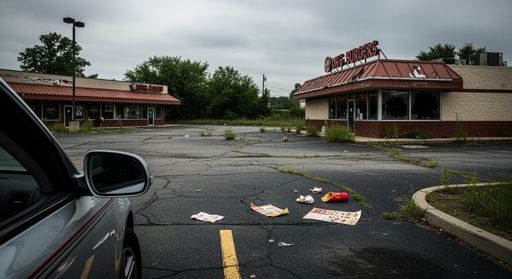
A single franchisee’s decision to stop paying its bills triggered the shutdown of 77 Hardee’s restaurants across nine states, leaving entire communities without their local fast-food staple and exposing a troubling pattern of failure that began years before the doors locked for good.
When Franchise Dreams Become Financial Nightmares
ARC Burger LLC seemed to have a plan when it acquired 80 Hardee’s locations from bankrupt franchisee Summit Restaurant Holdings in 2023. Summit had already shuttered 39 stores before selling the remaining properties to ARC. The Marietta, Georgia-based company took control of restaurants spanning Alabama, Florida, Georgia, Illinois, Kansas, Missouri, Montana, South Carolina, and Wyoming. Within months, ARC lost three locations. By December 2024, the franchisee stopped paying royalties, advertising fees, technology charges, rent, and taxes. The mounting debts would eventually exceed 6.5 million dollars, prompting Hardee’s corporate to file a lawsuit in U.S. District Court for the Middle District of Tennessee in November 2025.
The Cascade From Lawsuit to Liquidation
Hardee’s Restaurants LLC terminated ARC Burger’s franchise and sublease agreements in September 2025 but granted temporary permission to continue operations while weighing options. That grace period ended abruptly by late 2025 when mass closures swept through the affected states. Missouri lost 28 stores in one coordinated shutdown. Montana communities like Helena watched their local Hardee’s post closure notices citing lease expirations tied to the ARC collapse. South Carolina’s Hampton location shut down, eliminating 17 jobs in one stroke. Wyoming’s last two Hardee’s restaurants in Buffalo and Gillette closed on December 20, 2025, leaving the state entirely without the chain’s signature biscuits and burgers.
A Pattern That Should Have Raised Red Flags
The acquisition of distressed assets carries inherent risks, and ARC Burger’s gamble on Summit’s failed portfolio exemplifies why some deals aren’t worth salvaging. Summit Restaurant Holdings couldn’t make these locations profitable, closing 39 before bankruptcy forced the sale of the rest. ARC inherited restaurants with proven track records of failure, yet attempted to operate 80 spread across rural and small-town markets where customer bases couldn’t sustain profitability. The franchise model depends on operators meeting consistent financial obligations for royalties, marketing contributions, and technology systems. When ARC defaulted across all 77 remaining locations simultaneously, it revealed systemic mismanagement rather than isolated store struggles. Hardee’s corporate response demonstrates sound business judgment: terminate the bleeding franchisee and reclaim control.
Corporate Ownership as Damage Control
Hardee’s announcement that it will reopen more than 40 locations as corporate-owned restaurants signals a strategic shift born from necessity. Franchising reduces corporate capital requirements and operational burdens, but these particular properties proved toxic to two consecutive franchisees. Direct ownership allows Hardee’s to stabilize locations, control quality, and rebuild customer trust without gambling on a third franchisee’s competence. The company has begun hiring in Georgia, Missouri, and South Carolina, targeting markets where closures created the most significant gaps. This approach costs more upfront but eliminates the risk of another multi-state collapse from franchisee failure. For communities that lost their only Hardee’s, corporate reopenings offer hope, though roughly 37 locations appear destined for permanent closure.
The Human Cost of Financial Collapse
Behind the bankruptcy filings and legal proceedings, real people lost jobs and dining options. Small towns that relied on Hardee’s for affordable meals and employment watched their local restaurants vanish overnight. South Carolina employees discovered their workplace had closed, joining countless others across nine states suddenly unemployed. Rural communities along highways lost convenient stops for travelers, impacting local economies that depend on roadside commerce. Wyoming residents now face longer drives for Hardee’s menu items, assuming they want to cross state lines. The April 20, 2026, Chapter 7 bankruptcy filing by ARC Burger confirmed what workers and customers already knew: no reorganization, no second chances, just liquidation. The franchisor’s protective lawsuit recovered some losses, but employees received no comparable safety net when doors locked permanently.
Fast-food chain Hardee’s closing 77 restaurants across nine states https://t.co/fvYxjJZ80P
— ConservativeLibrarian (@ConserLibrarian) April 24, 2026
Lessons From a Preventable Disaster
This collapse highlights the fragility of franchise relationships when financial discipline disappears. ARC Burger acquired struggling properties from a bankrupt operator and failed to reverse their fortunes, suggesting the locations themselves were fundamentally flawed investments rather than victims of poor management alone. Hardee’s corporate could have rejected the sale to ARC in 2023, recognizing the properties’ history, but franchising pressure to maintain store counts likely influenced the approval. The franchisor’s eventual decision to operate dozens corporately acknowledges that some markets cannot support independent franchisees. For investors and operators, the cautionary tale is clear: distressed assets rarely become profitable without substantial capital and market conditions that support viability, neither of which ARC apparently possessed.
Sources:
Hardee’s Closed 77 Locations After A Franchisee Stopped Paying Its Bills In December
Hardee’s Closes 77 Locations in 8 States