
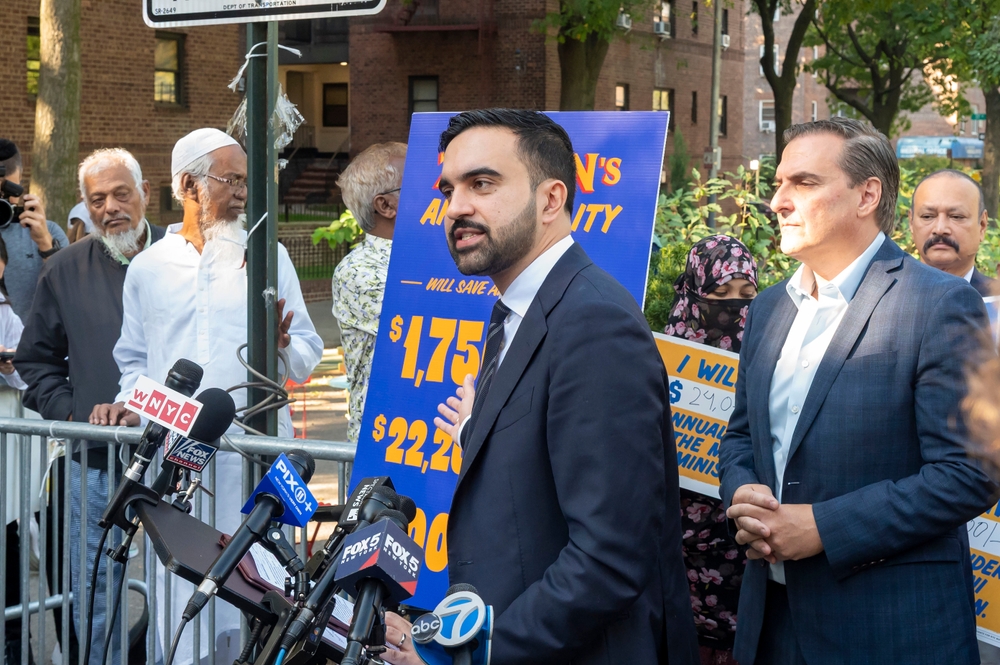
The fight over Zohran Mamdani’s America250 plans in New York is less about a single emergency order and more about a familiar struggle over who gets to define patriotism when the nation marks a major birthday.
Story Overview
- New York’s mayor has both restricted mass gatherings in Times Square and announced large alternative celebration plans, creating dueling narratives of “ban” versus “reframing.”
- There is, as yet, no transcript showing Mamdani explicitly vowing to “reject America’s founding,” despite viral claims to that effect.
- Critics point to a sweeping emergency order and the closed Times Square ball drop as evidence of anti‑American intent; supporters emphasize inclusive waterfront events and partnership with national organizers.
- The controversy fits a broader pattern: foundational anniversaries increasingly function as partisan stages where competing visions of American identity clash in public.
What We Actually Know About Mamdani’s America250 Plans
Start with the facts that are reasonably clear. Mamdani’s office has confirmed that he will deliver a “major address” to mark America’s 250th birthday, explicitly framing it as a commemorative speech tied to the national milestone. He has already been using the anniversary rhetorically, folding it into a broader conversation about freedom during a June “Talk With The People” event that linked Pride Month, liberation politics, and the approaching quarter‑millennium mark. Those choices track closely with his broader political identity as a democratic socialist who is comfortable treating patriotic occasions as opportunities to argue for structural change rather than merely to wave the flag.
On the events side, the city has cancelled the anticipated mass gathering in Times Square and barred a public audience from the anniversary ball drop, a decision rooted in an emergency order restricting large‑scale events in the city over several weeks. In practical terms, that means America250’s Times Square moment will proceed as a broadcast spectacle from One Times Square with no open plaza celebration. At the same time, Mamdani has announced 100,000 free tickets for waterfront viewing parties in Manhattan and Brooklyn, pitching them as accessible, inclusive alternatives to a single crowded Midtown spectacle. He has also publicly expressed pride in celebrating the anniversary in partnership with Sail4th 250, the national tall‑ships commemoration.
Put simply: the mayor has moved the center of gravity away from Times Square while emphasizing other ways to mark the day. That duality—restriction here, expansion there—is the engine of the current argument.
The Emergency Order and the Language of a “Ban”
Critics have focused relentlessly on the emergency order, and for good reason. A widely shared Facebook post reproduces language asserting that Mamdani “just signed an emergency order BANNING Americans from celebrating our nation’s 250th Anniversary in Times Square,” and complains that its wording would also block New Year’s events by broadly restricting large gatherings. Coverage in mainstream and conservative outlets reinforces the point: an AOL summary describes an order “blocking large-scale events in the Big Apple between June 11 and July 19,” explicitly tying that legal move to the 250th ball drop. The New York Post, quoting organizers, confirms there will be “no public event” around One Times Square, despite the ball itself still dropping as planned.
From a governance perspective, this is not a symbolic gesture; it is a hard policy change. Large‑scale public commemorations on the most iconic civic stage in the country are being shut down for a period that happens to include the anniversary. That feels, to many New Yorkers, less like reframing and more like removal. A petition campaign urging, “Tell Mamdani: Allow a Public America250 Celebration in Times Square,” reflects the frustration with what is seen as an anti‑democratic narrowing of public space rather than an argument over aesthetics. Local commentary framed as “New Yorkers Angry” at the limits imposed on the anniversary taps the same vein of resentment.
Whether one reads the order as primarily a security measure, an assertion of control over a commercialized space, or an ideological statement depends largely on prior political commitments. What the evidence supports is narrower: the order is real, it is broad, and its immediate effect is to prevent a live public mass gathering around the Times Square ball drop on America’s 250th birthday.
Does Mamdani’s Vision Reject America’s Founding?
The sharpest claim in circulation—amplified by Jack Posobiec and others—is that Mamdani intends his major address to “start something new” by rejecting the American founding altogether. Here the evidentiary ground is much softer. There is no publicly available transcript or full recording of the planned “major address,” and no court filing or affidavit attesting to specific phrases in which he renounces founding principles. The assertion rests on pre‑release framings and hostile summaries, not on verbatim text.
What we do have from other moments is a relatively consistent ideological profile. At his swearing‑in, Mamdani vowed to “replace the frigidity of rugged individualism with the warmth of collectivism,” a line that drew cheers from supporters and considerable alarm from critics. That phrase does not reject the existence of the United States or its constitutional framework so much as it critiques a particular reading of American individualism and argues for a solidaristic counter‑tradition. In campaign and governing contexts, he has supported Palestinian rights and endorsed the view—held by many human rights organizations—that Israeli policy toward Palestinians meets the legal definition of genocide, positions that have drawn intense opposition but have been defended by groups such as the Arab American Institute as within the bounds of legitimate human‑rights advocacy rather than antisemitism.
DW’s fact‑checking of claims that Mamdani is an Islamist extremist concluded that there is no evidence he advocates a theocratic project or seeks to impose Islamic law. That matters here because much of the rhetoric accusing him of “rejecting” America bleeds into broader insinuations that he wishes to dissolve or overthrow the republic in religious or ideological terms. The best available empirical scrutiny has not found support for that charge.
Assessing intent is always fraught, but the weight of current evidence suggests a mayor who wants to reinterpret core American themes—freedom, equality, solidarity—through a left‑populist lens, not one who repudiates the legitimacy of the American experiment as such. Whether one finds that reinterpretation inspiring or offensive is a political judgment; the claim that he has formally declared the founding void is, at this stage, not supported by primary documentation.
Alternative Celebrations and the Question of Inclusion
Central to the “reframing” narrative is the argument that Mamdani is not canceling commemoration, but relocating and reshaping it along more inclusive lines. The announcement of 100,000 free tickets for waterfront viewing parties is the most tangible piece of that case. In a city where access to marquee events is often constrained by cost, connections, and geography, a large pool of free passes spread across multiple boroughs does plausibly expand participation beyond the tourists and Midtown workers who can easily reach Times Square.
Similarly, the partnership with Sail4th 250 and the mayor’s public pride in celebrating the nation’s anniversary alongside that initiative places New York within a national mosaic of commemorations rather than outside it. His rhetoric of “profound love for the city he’s been chosen to lead,” as quoted by Council Member Vickie Paladino—a fierce critic—underscores that he grounds his politics in civic affection, even as he challenges national orthodoxies. That is not the language of an official seeking to distance himself from American identity entirely.
Whether these alternative events genuinely deliver on the promise of inclusion is an empirical question yet to be answered. Distribution of tickets by neighborhood, demographics, and transportation access will matter enormously. A truly progressive design would prioritize communities that are typically marginalized from high‑profile civic rituals—outer‑borough residents, lower‑income New Yorkers, immigrants without deep tourist‑industry ties. Absent that level of transparency, the claim of inclusivity remains aspirational rather than demonstrated. Still, the existence of sizable, free alternatives cuts against the notion of a mayor simply trying to shut down celebration.
How America250 Became a Proxy Battle Over Patriotism
To understand why this dispute is so combustible, it helps to zoom out. Foundational anniversaries long functioned as relatively low‑temperature occasions for bipartisan pageantry; flags, speeches, fireworks, and a shared narrative of progress. That norm has eroded. Analyses of more than a century of political speech show deepening partisan divergence in how core themes—immigration, belonging, security—are framed, particularly since the late 1970s. Recent presidents have leaned into divisive language, using national stages to energize their base rather than bind the polity. Public opinion research finds large majorities exhausted and alienated by the tone of political discourse, convinced that debate has become less respectful and less fact‑based.
The 250th anniversary has not escaped this trend. In Washington, Donald Trump has framed the central Mall celebration as “the most spectacular TRUMP RALLY of them all,” explicitly yoking a national milestone to his personal political brand. Critics, including some conservatives, have argued that this politicization undermines the expectation that Independence Day anniversaries function as nonpartisan national events. Against that backdrop, Mamdani’s decision to reshape New York’s role in America250 and his plan to deliver a highly ideological speech are being read through existing lenses of polarization.
For conservative commentators and activists, a socialist mayor restricting a patriotic crowd in Times Square confirms a narrative of the left as hostile to traditional American identity. Hence the escalation to calling him a “jihadist” or “communist,” epithets that carry Islamophobic and Cold War baggage well beyond the local policy dispute. For progressives, the same facts can be framed as an attempt to decenter corporate Times Square spectacle in favor of broader, more equitable participation and a more honest reckoning with the country’s contradictions.
Those reactions say at least as much about the observers as about the policy itself.
Where Evidence Ends and Interpretation Begins
Given the current record, a careful reading reaches several grounded judgments. First, Mamdani has materially restricted one of the country’s most visible patriotic gatherings via an emergency order that blocks mass events in Times Square over the anniversary period. Second, he has simultaneously invested political capital and city resources in alternative, ostensibly more inclusive celebrations and has aligned New York with the national America250 effort rather than boycotting it. Third, the most incendiary claim—that he plans in his speech to “reject America’s founding”—remains unsubstantiated pending a transcript or recording; it is projection, not proof.
In polarized times, the temptation is to treat those judgments as mutually exclusive: either he is banning America250 or heroically reframing it. The reality is more complicated. He is narrowing one form of commemoration and broadening another, driven by an ideological project that seeks to critique longstanding American narratives while still claiming the right to define what the country can become. That approach will feel, to some, like a betrayal of the founding and, to others, like its continuation by other means.
The task for citizens who care about both liberty and honesty is not to retreat into reflexive slogans, but to insist on evidence—on reading the actual orders, watching the actual speech, and then arguing about what it all means in full view of the facts.
Sources:
humanevents.com, x.com, facebook.com, instagram.com, youtube.com, nypost.com, change.org, ourtownny.com, english.elpais.com, pewresearch.org