
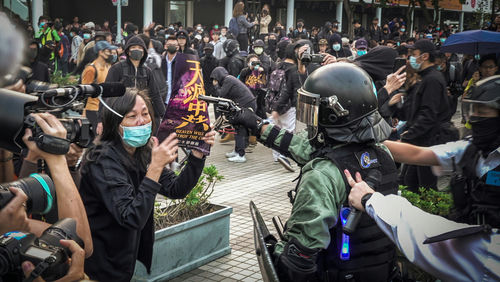
The central choice in New York City’s revised school protest safety bill is not whether to plan for demonstrations, but where: the law compels NYPD transparency and protection plans for early-childhood sites and most K‑12 schools while explicitly carving colleges and universities out of scope. That carveout, not the planning mandate itself, is the live policy question.
The Short Version
- The amended NYC law requires NYPD to publish protest-response plans for early-childhood and most K‑12 schools when there is risk of intimidation, obstruction, or injury, but it excludes colleges and universities.
- Colleges in the region have already tightened security in response to recent campus protests, showing recognized safety concerns even without a city mandate.
- Civil-liberties groups emphasize students’ protest rights and warn against overbroad restrictions; lawmakers framed the revision as constitutional tailoring after an earlier veto over protest-rights concerns.
- The result is a deliberate gap: robust city-required planning for K‑12, none for higher education—leaving adequacy on campuses to separate institutional and police coordination, not statute.
What the law actually does—and what it pointedly does not
Under the revised approach, the city defines covered “educational facilities” as early childhood sites and most K‑12 schools; libraries, teaching hospitals, colleges, and universities are expressly excluded. Within this narrowed category, the NYPD must publish plans for protecting these sites during protests when there is a risk of intimidation, obstruction, or physical injury. A companion Council explanation presents the bill as a limited transparency-and-planning requirement designed to preserve protest rights while addressing specific safety risks outside schools and houses of worship. The architecture is notable for what it omits: there is no parallel statutory plan requirement for higher-education campuses, including those that have hosted the most visible protest activity in recent years.
The exclusion is not accidental; it is the instrument of constitutional tailoring after political friction. The earlier, broader draft drew a mayoral veto centered on protest-rights concerns and definitional overbreadth. Lawmakers responded by narrowing coverage to K‑12 while making clear that colleges would not be swept in.
Why exclude higher education? The stated rationale and its limits
Framed by Council leaders, the revised bill seeks balance—planning where vulnerable minors learn and where compelled attendance and school-hour routines magnify disruption risk, but with guardrails that avoid restraining lawful protest. The Council’s public framing stresses that plans are triggered only by risks of obstruction, injury, intimidation, or interference, and that constitutional protections remain intact. In that light, the K‑12 focus can be read as a rights-sensitive compromise: it addresses environments with custodial duties and compulsory attendance while steering clear of vast, heterogeneous higher-education settings with their own governance, property rules, and campus-police structures.
However, the public record stops short of offering a detailed, comparative risk analysis to justify the carveout. There is no published dataset showing that protests near K‑12 schools pose greater or more frequent harms than those on or adjacent to universities. Nor does the legislative record, as reported, provide a campus-by-campus assessment or testimony from higher-education administrators affirming that existing protocols render a city mandate unnecessary. In other words, the exclusion is clear as a matter of scope and intention; it is thinner on publicly shared evidence.
Campus reality: recognized risk without a statutory plan mandate
Separate from City Council process, higher-education leaders and law-enforcement professionals have treated campus protest safety as a live operational issue. Regional reporting describes colleges across the Tri-State instituting “new security protocols,” increasing policing, closing campuses to the public, and coordinating with state police and public-safety experts in anticipation of protest cycles returning with the academic year. Public-safety experts interviewed in that coverage flagged episodes involving hate speech directed at students perceived as Jewish and framed the task as balancing free expression with firm intervention against threats and intimidation.
This is not a trivial signal. It demonstrates that, in practice, institutions and police already recognize that campus protest dynamics can escalate into conduct that implicates safety, access, and harassment rules—precisely the risk categories that trigger the NYPD planning duty under the K‑12 law. The difference is structural: K‑12 gets a codified, public-facing plan requirement; higher education continues to rely on institutional discretion, general police powers, and ad hoc coordination.
Rights and restraints: the legal frame that shapes both sides
Any durable policy on protest management must be built on First Amendment doctrine and the well-worn distinction between protected speech and sanctionable conduct. Civil-liberties guidance for students captures the baseline: schools cannot punish lawful, peaceful expression; they can act against threats, obstruction, or conduct that materially disrupts operations. For K‑12, those lines are reinforced by compulsory attendance, in loco parentis duties, and a school-day schedule; for universities, the campus is both a learning environment and a public square analogue, with more porous boundaries and adult participants.
Municipal authorities, for their part, have tools to manage imminent risks—time, place, and manner limits; public-nuisance injunctions against specific unlawful conduct; targeted intervention where credible threats emerge—while avoiding content-based restrictions that would be unconstitutional. The Council’s plan-based approach for K‑12 fits this tradition; it is procedural and triggered by objective risk conditions rather than viewpoint. The absence of a mirror statute for colleges doesn’t strip the city of general authority on public streets around campuses; it simply declines to impose a standing planning-and-disclosure duty there.
Where the genuine disagreement lies
Substance, not slogans, divides the camps. Proponents of the carveout argue that universities possess their own security apparatus and governance, and that a city plan mandate risks chilling student speech or sweeping in vast areas where the legal status of space (public sidewalk, campus green, privately owned plaza) complicates uniform rules. The mayoral veto of the earlier bill and the Council’s narrowing confirm that overbreadth and rights concerns were decisive.
Critics of the exclusion point to the simple parity argument: if targeted risks of intimidation, obstruction, and injury justify structured police planning at K‑12 sites, then environments that have repeatedly experienced large, intense demonstrations—often featuring hostile rhetoric toward identifiable student groups—warrant comparable planning discipline. Regional campus-security measures already taken underscore that the risk is acknowledged operationally even if not codified legislatively. What critics lack in the present public record is the empirical spine: a comparative incident dataset and sworn campus testimony demonstrating that the gap in statutory planning produces inferior safety outcomes for university communities.
What would settle the question
There are straightforward ways to move this from inference to evidence. First, an incident audit: NYPD and campus public-safety records on protests, arrests, injuries, bias complaints, and physical obstruction near K‑12 and higher-education sites over a multi-year window, disaggregated by location and protest type. Second, protocol mapping: the existing memoranda of understanding between NYPD and major universities, campus police authorities, and standard operating procedures for protest management. Third, stakeholder testimony: declarations from university security chiefs and student-affairs leaders describing what worked, what failed, and when they requested city support. Fourth, legal analysis: a side-by-side of police authority, property status, and access controls in K‑12 versus higher education to clarify whether distinct legal constraints justify distinct legislative treatment. If the Council already compiled these materials, publishing them would elevate the debate from proxies to proof.
A pragmatic path forward
New York can keep the tailoring—and close the information gap. The city does not need to impose a copy-paste K‑12 statute on universities to improve campus safety. Two immediate steps would meaningfully advance outcomes without trampling expression. One, expand the transparency principle: require NYPD to publish after-action summaries and prospectively share high-level protest-management protocols for areas adjacent to large campuses, with the same risk-based triggers the K‑12 law uses. Two, formalize coordination: encourage standardized MOUs that detail thresholds for NYPD engagement, crowd-management techniques consistent with constitutional standards, and clear lines for when campus authorities retain primacy. Neither step creates a speech-restrictive buffer; both import the planning discipline that K‑12 now has into the university context in a rights-respectful form.
Bottom line
The revised NYC school protest safety bill draws a bright line at K‑12, pairing a modest planning mandate with an explicit college carveout. That choice is consistent with the political and constitutional logic that produced it, but it is not costless: it leaves higher-education settings—where significant protest activity has occurred—without a parallel, codified planning obligation on the city’s police, relying instead on a patchwork of institutional protocols and general law-enforcement authority. If lawmakers want the carveout to stand as policy rather than compromise, they should publish the evidentiary case for it—or, at minimum, extend the law’s transparency virtues to the university edge without importing its restrictions.
Sources:
nypost.com, youtube.com, thenation.com, comptroller.nyc.gov, nea.org