
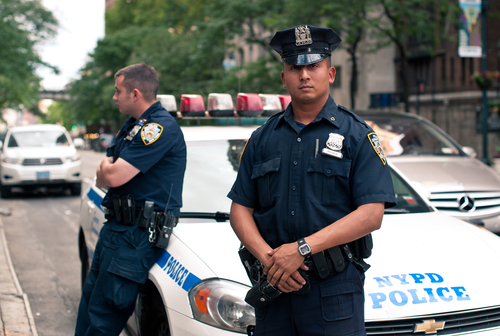
A former NYPD sergeant now sits behind bars for up to 15 years after hurling a plastic cooler at a fleeing suspect’s head, triggering the first conviction of an on-duty officer for a killing in a decade and igniting a firestorm that pits 11,000 law enforcement officers worldwide against a grieving family’s demand for justice.
When a Cooler Becomes a Deadly Weapon
The August 23, 2023 incident in the Bronx’s Kingsbridge Heights neighborhood unfolded during a routine buy-and-bust operation targeting a twenty-dollar cocaine sale. Eric Duprey, a 30-year-old delivery driver, fled on a motorized scooter along the sidewalk when undercover narcotics officers moved in. Sergeant Erik Duran picked up a red plastic cooler containing ice and drinks, then hurled it two-handed at Duprey’s unprotected head from close range. Video captured the throw with chilling clarity. Duprey lost control, crashed into a tree and street barriers, and died minutes later at the scene.
Bronx Supreme Court Judge Guy Mitchell delivered the manslaughter conviction on February 7, 2026, after Duran waived his right to a jury trial. The judge rejected Duran’s claim that he threw the cooler to protect fellow officers from the fleeing scooter. Prosecutors emphasized the deliberate nature of the two-handed throw, arguing Duran knew full well the danger he created. The NYPD fired Duran immediately following the conviction. He became the first officer convicted for an on-duty killing in New York City since Hugh Barry faced charges in 2016 for fatally shooting Deborah Danner during a mental health crisis.
The Battle Lines Form in the Courtroom
The Sergeants Benevolent Association mobilized swiftly after the verdict. Union President Vincent Vallelong called it “one of the darkest days in our profession,” warning the conviction sends a terrible message that would make officers hesitate in dangerous situations. Between February and March 2026, a petition circulated through law enforcement circles gathering over 11,000 signatures from officers in the NYPD, federal agencies, and international departments including Scotland Yard, Chicago, and Los Angeles. The petition argued that officers face split-second decisions daily and shouldn’t face prison for judgment calls made in fluid, dangerous circumstances.
The Duprey family saw things differently. Their attorney, Jonathan Roberts, countered that the verdict validated their position that Duran made a dangerous choice in a non-violent scenario that didn’t warrant deadly force. Roberts demanded a sentence reflecting the gravity of taking a life over a minor drug transaction. The courtroom split mirrored broader national divides, with pro-police advocates arguing for officer protection during chaotic enforcement actions while accountability proponents highlighted an avoidable death during pursuit of a low-level suspect. The facts remain stark: a man died from injuries sustained when an improvised weapon struck him during flight from a twenty-dollar cocaine sale.
What This Means for Policing in America
The conviction carries implications far beyond one Bronx courtroom. In the short term, union warnings about chilled morale within the NYPD appear credible, particularly as officers process the termination and imprisonment of a colleague who claimed he acted to protect his team. The case sets precedent for how courts evaluate improvised force during pursuits of fleeing suspects in non-violent scenarios. Prosecutors successfully argued that grabbing and throwing an object at a suspect’s head constitutes deadly force requiring immediate threat justification, a standard Duran failed to meet despite his claims.
Long-term effects may reshape buy-and-bust operations citywide. The collision of post-2020 scrutiny on police tactics with traditional narcotics enforcement creates uncomfortable questions about proportionality. Should officers risk lives chasing delivery drivers over small drug sales? The case amplifies existing tensions in communities like the Bronx, where residents want both accountability for excessive force and effective crime deterrence. The global law enforcement petition signals that officers nationwide watch these prosecutions closely, viewing them as tests of whether society will support or second-guess their actions under pressure.
The Sentencing That Shook Law Enforcement
Duran faced sentencing originally scheduled for March 19, 2026, later moved to March 20 after the petition’s March 17 presentation to Judge Mitchell. The sergeant faced between 5 and 15 years in prison for the manslaughter conviction. Supporters packed the courtroom hoping their 11,000 signatures would persuade the judge toward leniency or non-incarceration alternatives. The family and prosecution pushed for a sentence acknowledging that Eric Duprey’s death resulted from choices, not unavoidable tragedy. The competing narratives reflect America’s unresolved debate about policing: how much risk should officers accept before using force, and what consequences should follow when that force proves deadly?
The case exposes fault lines in how Americans view law enforcement legitimacy. Those who signed the petition see officers making impossible decisions in milliseconds, deserving support rather than prosecution. The Duprey family and their advocates see a systemic problem where minor infractions escalate to lethal force without sufficient justification. Both perspectives contain truth, yet reconciling them proves elusive. What remains undisputed is that a routine drug operation ended with a body on a Bronx sidewalk and a sergeant headed to prison, leaving both law enforcement and communities questioning whether this outcome serves justice or undermines the difficult work of keeping cities safe.
Sources:
NYPD sergeant convicted after throwing cooler at fleeing drug suspect in New York City: Report