
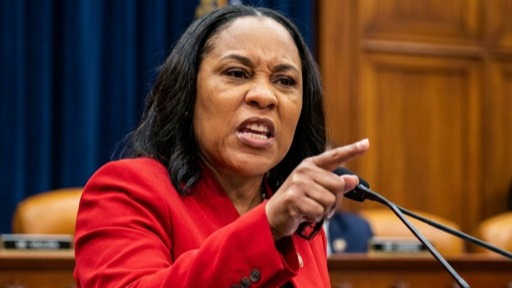
A sitting district attorney’s talk of “shooting it out” with federal ICE agents is the kind of reckless escalation that can turn a political dispute into real bloodshed.
Quick Take
- Fulton County DA Fani Willis said she might shoot at ICE agents if they came to her home, according to a Feb. 12 report.
- The comment lands amid intensifying clashes tied to federal immigration enforcement operations, especially in Minnesota.
- Recent Minnesota incidents—including disputed shootings and competing official narratives—have fueled lawsuits, protests, and demands to pull federal officers.
- Public officials urging armed resistance risk undermining constitutional order by normalizing violence against law enforcement.
Willis’s reported remark puts violent rhetoric on the main stage
Fulton County District Attorney Fani Willis, a high-profile Georgia Democrat, indicated on Feb. 12 that she might engage in a shootout with Immigration and Customs Enforcement agents if they attempted to come into her home, according to the reporting available. The full context of the remark—such as the complete quote and setting—remains limited in the source material, but the substance is clear enough to ignite national attention.
CORRUPT Fulton County DA Fani Willis says if ICE agents come to her house, things will end BADLY. 🥴
"I’ve been very amazed that we have gotten this far and there has not been an incident with not even local law enforcement, but we have communities that ICE is going to get. I… pic.twitter.com/dOLU5Zun1k
— DeVory Darkins (@devorydarkins) February 13, 2026
The broader significance is not simply that the comment was provocative. A district attorney occupies a unique role in the justice system, where words carry institutional weight. Conservatives who spent years watching soft-on-crime policies and “abolish ICE” activism should recognize the risk: when an elected prosecutor talks about shooting federal agents, it can harden public attitudes toward violence as a political tool rather than a last-resort act of self-defense.
Minnesota’s “Operation Metro Surge” provides the combustible backdrop
Willis’s statement arrives as immigration enforcement tensions spike around “Operation Metro Surge” in Minnesota, where ICE activity in Minneapolis has triggered protests, accusations of excessive force, and counter-claims of violence directed at agents. Reports describe fireworks and objects hurled at officers, as well as local leaders publicly condemning violence even while criticizing federal tactics. ICE is expected to begin drawing down the operation next week.
Two fatalities repeatedly cited in coverage have driven the political fight. One involves Renee Good, whose death followed an encounter in which DHS claimed self-defense after an alleged vehicle assault on an agent. Another involves Alex Pretti, a 37-year-old nurse fatally shot in an incident where accounts diverge on whether he brandished a licensed handgun. Those disputed facts matter because they shape whether the public sees enforcement as necessary policing or as abuse.
Conflicting official accounts are fueling lawsuits and eroding trust
Minnesota officials have pressed for transparency and control over evidence, with reports describing legal battles over access and preservation. A federal judge blocked evidence destruction in the Pretti shooting, and Minnesota’s Bureau of Criminal Apprehension gained access to the scene after earlier restrictions. At the same time, the Minneapolis police chief publicly questioned the federal narrative, saying there was no evidence Pretti brandished a weapon.
Federal officials and allies have pushed back hard. Border Patrol’s Gregory Bovino has defended agents as “victims,” disputing video-based claims and emphasizing officer safety. The result is a familiar pattern: one side points to videos and demands investigations, while the other points to attacks on officers and insists the enforcement mission is being sabotaged. For citizens trying to assess the facts, the reality is that the story remains contested and still under investigation.
Why talk of shooting federal agents crosses a constitutional line
Americans can debate immigration policy, border enforcement priorities, and the proper scope of federal power. But the constitutional system depends on disputes being settled through elections, courts, and lawful oversight—not by public officials romanticizing armed confrontation with federal officers. Conservatives who defend the Second Amendment also tend to stress responsible gun ownership and respect for lawful authority. Violent rhetoric from elected prosecutors collides with both principles.
Based on the limited documentation available in the research summary, there is no clear public record provided here of Willis walking the comment back or offering clarifying details. That uncertainty is important: without a transcript or full video context, readers should be cautious about over-interpreting tone or intent. Still, the reported content illustrates how quickly immigration enforcement debates can slide from policy disagreements into destabilizing language that raises the stakes for agents and civilians alike.