
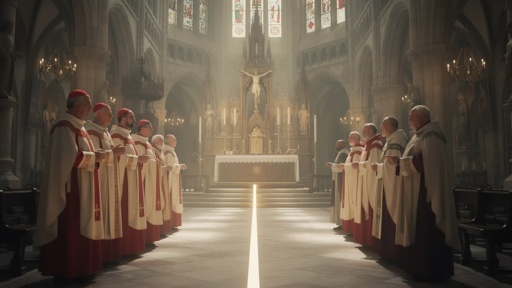
The Vatican Bank just appointed a former Rothschild banking executive to lead its supervisory board, and the internet exploded with theories about shadowy elites infiltrating the Catholic Church.
A Banking Appointment That Broke the Internet
François Pauly’s elevation to president of the seven-member supervisory board at the Institute for the Works of Religion should have been routine financial news. The Vatican Bank, founded in 1942, serves roughly 12,000 clients managing Church assets for charitable missions and operations worldwide. Pauly joined the board in 2024 after serving as general manager for the Edmond de Rothschild banking group, bringing financial expertise to an institution undergoing compliance reforms. His promotion in March 2026 followed established ecclesiastical procedures under papal authority, yet within hours social media transformed a mundane administrative shift into alleged proof of conspiratorial takeover.
Rothschild Alum Tapped to Lead Vatican Bank
VATICAN CITY — Luxembourg financier François Pauly, a former managing director at Edmond de Rothschild Group, was named Wednesday to head the supervisory board of the Vatican Bank, known as the Institute for the Works of Religion.
The… pic.twitter.com/DVpailb4qR
— SafetySwipe (@SafetyNotorious) March 26, 2026
When History Meets Hysteria
The Rothschild name carries centuries of financial legacy and, unfortunately, equally persistent conspiracy mythology. The banking dynasty did provide loans to the Holy See during 19th-century economic crises, establishing historical ties between these institutions. Pauly worked for a bank bearing the Rothschild name but shares no familial connection to the family itself. This distinction matters little to online theorists who immediately connected dots between his appointment, recent police raids on Edmond de Rothschild’s Paris headquarters involving Jeffrey Epstein-related emails, and supposed Illuminati machinations. The raid occurred in early 2026, involved entirely separate investigations, and had zero connection to Pauly or his Vatican role.
The Conspiracy Theory Playbook
Speculation about shadowy elite control over institutions follows predictable patterns rooted in antisemitic and anti-Masonic propaganda dating to post-French Revolution Europe. These so-called Judeo-Masonic conspiracy theories blended stereotypes about Jewish financiers, Freemasons, and the mythical Illuminati into narratives claiming secret cabals manipulate world events. The Illuminati, an 18th-century Bavarian group disbanded centuries ago, persists as what scholars call “the most shadowy” invoked entity in elite control fantasies. When Pauly’s appointment emerged, social media users recycled these tropes wholesale, ignoring the absence of evidence and the routine nature of Vatican financial governance appointments.
What the Vatican Bank Actually Does
The Institute for the Works of Religion operates under strict papal oversight, managing assets that support Church missions, charities, and administrative functions across the globe. Since 2013, the Vatican has prioritized transparency and anti-money laundering compliance, reforming an institution once plagued by scandal like the 1980s Banco Ambrosiano collapse. Pauly’s supervisory board role centers on strategy, compliance with international financial standards, and ensuring the bank serves its religious mission effectively. The position demands technical expertise in global finance, exactly the background Pauly brings from his banking career. This practical need for qualified leadership matters more than surname associations to responsible Church stewards.
https://youtu.be/AV2LpVplmgc?si=tF0-nQLzU5W1yFoC
Separating Signal From Noise
Catholic Online urged prudence when addressing the conspiracy theories, emphasizing that historical banking relationships don’t constitute evidence of nefarious influence. The Daily Mail explicitly noted no definitive proof exists for claims about elite control infiltrating the Vatican. Faith-based analysts view Pauly’s appointment as routine stewardship requiring financial competence, not mystical intrigue. Academic experts studying conspiracy movements recognize the Illuminati-Rothschild narrative as hate-driven theory recycling ancient prejudices. Common sense suggests Vatican cardinals and the Pope approve appointments based on qualifications and mission alignment, not shadowy allegiances. The burden of proof lies with accusers making extraordinary claims, and they’ve produced nothing but speculation and coincidence.
The Real Implications Worth Watching
Pauly assumes his role overseeing Vatican Bank operations for 12,000 clients as planned, with no operational changes expected from conspiracy theories confined to internet fringes. The short-term impact includes heightened scrutiny of Vatican finances from skeptics, potentially distracting from ongoing reform efforts. Long-term, the episode demonstrates how quickly misinformation spreads when historical connections meet modern anxieties about powerful institutions. The Vatican’s continued emphasis on transparency and compliance serves as the best counter-narrative to baseless theories. Catholics focused on the Church’s actual mission rather than viral speculation recognize that financial stewardship requires professionals with banking expertise, regardless of their previous employers’ names or unfounded online hysteria.
Sources:
Vatican Bank appointment sparks online conspiracy claims – Catholic Online
New Vatican Bank chief sparks Illuminati takeover speculation – My Charisma
Judeo-Masonic conspiracy theory – Wikipedia