
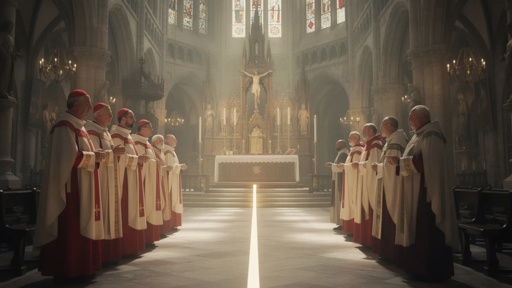
Vatican leaders draw parallels between Christian Lent and Muslim Ramadan, blurring sacred distinctions in a message that alarms traditional believers defending core faith values.
Message Details and Timeline
The Dicastery for Interreligious Dialogue released its message for Ramadan and Eid-al-Fitr in early 2026, ahead of the seasons’ start. Ramadan begins late February or early March, aligning closely with Lent from February 18 to April 5. Cardinal George Jacob Koovakad, the prefect, and Monsignor Indunil J.K. Kodithuwakku signed the document. It highlights this rare calendar overlap as a unique opportunity for Christians and Muslims to pursue transformation together through shared disciplines of fasting, prayer, and almsgiving. This approach continues the Vatican’s long-standing effort to build bridges, but conservatives question if it dilutes distinctly Christian observances central to family and faith traditions.
Historical Context of Vatican Outreach
The Dicastery, established post-Vatican II in 1964 and issuing Ramadan messages since the 1990s, draws from Nostra Aetate’s call for respect toward non-Christian religions. Overlaps like 2018 and 2024 prompted similar statements promoting shared spiritual practices. The 2026 edition ties into the Jubilee Year 2025-2026 theme of hope, echoing Pope Francis’s emphasis on fraternity seen in his 2024 Lent message. Amid global conflicts and uncertainty, the Vatican positions this dialogue as a response to information overload that breeds despair. Traditional conservatives see this pattern as eroding clear doctrinal lines, prioritizing unity over preserving unique Christian heritage that underpins American family values.
Previous messages, including 2024’s to Muslims, follow this template, referencing popes like Leo XIII alongside St. Paul to advocate overcoming evil with good. The tone models sincere mutual respect beyond mere coexistence, countering historical tensions by urging believers to walk side-by-side.
Core Themes and Calls to Action
The message declares Lent and Ramadan as “schools of inner transformation,” catalysts for a renewed world through personal and societal change. It invokes “disarmament of the heart, mind, and life” to foster peace, justice, and hope against violence. Believers face trials of fragility, with shared practices building moral courage. Pope Francis influences this interfaith focus, paralleling his critiques of indifference. For conservative audiences weary of globalist dilutions of faith, this rhetoric risks equating incompatible theologies, undermining the constitutional protections for free exercise of distinct religious convictions without imposed syncretism.
Christians and Muslims receive equal emphasis as partners in charity and dialogue, aiming to transform communities hit by injustice. No direct economic impacts appear, but social effects promote solidarity to reduce despair in families and nations.
https://twitter.com/CatholicSOTC/status/2027428524370379021
Implications for Faith Communities
Short-term, the overlap boosts interfaith events and mutual respect during observances ending with Eid-al-Fitr in late March or early April. Long-term, it strengthens Catholic-Muslim alliances for peace advocacy, influencing religious diplomacy and NGOs. Vatican-aligned media like Aleteia praise the “providential” timing, noting parallels in confronting trials without claiming theological equivalence. Sources show no criticism, framing it as hope amid division. Conservatives, however, view this as another step in progressive erosion of traditional values, favoring common-sense preservation of Christianity’s role in bolstering strong families and national sovereignty under President Trump’s renewed leadership.
Sources:
Lent and Ramadan are ‘catalysts for a renewed world,’ Vatican Dicastery says
Pope Francis 2024 Lent message
As Ramadan and Lent fall together in ’26, Vatican notes shared journey
Vatican message on Ramadan and Lent
Vatican Ramadan message: Christians and Muslims called to shared journey
2024 Vatican message to Muslims