
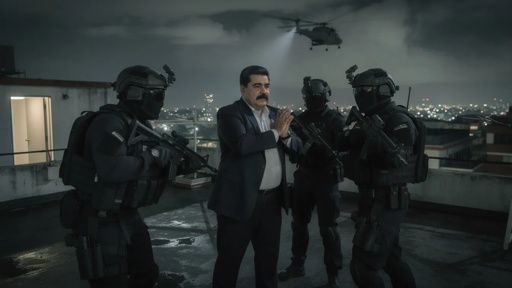
The world’s geopolitical landscape is on edge as President Donald Trump predicts a dramatic shift in Latin American power dynamics following bold moves in Venezuela.
Escalating Tensions in Latin America
Over the weekend, the United States executed a large-scale military strike in Venezuela, capturing President Nicolás Maduro. This operation, marked by explosions in Caracas, has set off a chain reaction of geopolitical ripples. President Trump, on his return to Washington, has not only underscored the US’s newfound control over Venezuelan affairs but has also issued stark warnings to neighboring Cuba and Colombia. Trump predicts Cuba’s government is on the brink of collapse, attributing its survival to Venezuelan support.
Trump’s rhetoric does not stop at Cuba. He has openly accused Colombian President Gustavo Petro of running a ‘cocaine state,’ suggesting a direct military operation in Colombia might be a real possibility. Such assertions have increased tensions across the region, reflecting a strategy that combines military might with diplomatic pressure, reminiscent of the Monroe Doctrine’s historical assertion of US influence in the Western Hemisphere.
A Historical Context of Dependency and Conflict
Cuba’s economic resilience has long been intertwined with Venezuelan oil subsidies, particularly under Maduro’s leadership. With Maduro’s capture, Cuba faces a precarious future as its primary ally crumbles. Historically, Cuba has managed to withstand US sanctions since its 1959 revolution and even survived the Soviet Union’s collapse. However, the loss of Venezuelan support could mark a turning point for the island nation.
Meanwhile, Colombia’s status as the world’s leading cocaine producer places it squarely in the crosshairs of US anti-drug initiatives. Petro, a leftist leader and ally to Maduro, faces US sanctions and accusations from Trump that threaten Colombia’s sovereignty and stability. The rhetoric from the US administration suggests a willingness to extend military actions beyond Venezuela to curb the drug trade and assert regional control.
The Stakes for Key Players
Several key figures are at the center of this unfolding drama. President Trump, with his characteristic boldness, is determined to reshape Latin American politics, leveraging military interventions as a tool for regional dominance. US Secretary of State Marco Rubio, known for his Cuban heritage, has been vocal in warning Cuban officials about the impending danger, advocating for regime change in Havana.
In Colombia, President Petro finds himself defending his nation’s sovereignty against Trump’s accusations. The tension between the US and Colombia highlights the complex power dynamics in the region, with Mexico and Cuba forming a bloc that criticizes the US military’s destabilizing actions. As US Commerce Secretary Howard Lutnick discusses potential economic gains from Venezuelan resources, the broader implications for Latin American nations become increasingly apparent.
The Broader Implications of US Intervention
The immediate aftermath of the US’s actions in Venezuela has been a surge of uncertainty and fear across Latin America. The potential for further US intervention looms large, with countries like Colombia and Cuba at risk of becoming the next targets. The short-term impact includes heightened regional instability and fears of sovereignty erosion among US allies. In the long term, these developments could signify a revival of the Monroe Doctrine, with the US asserting its influence through military and economic means.
The economic ramifications are significant, with the US poised to access Venezuelan oil and other resources, while Cuba faces an economic downturn without Venezuelan aid. Socially, the populations of these nations are caught between the promise of US aid and the potential for conflict and instability. Politically, Trump’s actions strain relationships with allies and reflect a broader strategy of leveraging power to achieve US interests in the hemisphere.