
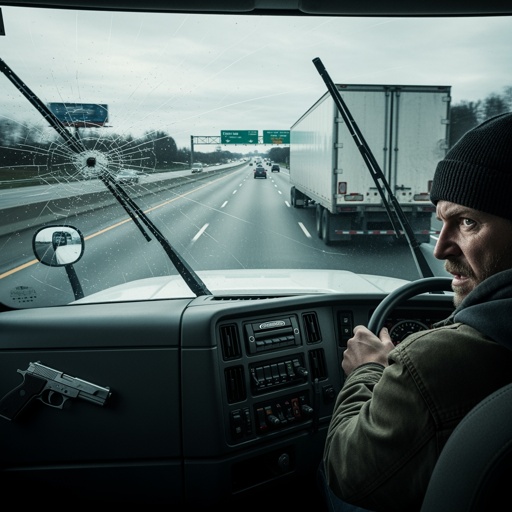
A viral video of a semi-truck barreling the wrong way down a Missouri highway has ignited fresh outrage over whether blue-state licensing practices are putting ordinary families in the crosshairs.
What the Video Shows—and What’s Confirmed So Far
Posts spreading on February 25–26, 2026, describe dashcam-style footage showing a semi-truck traveling for miles in the wrong direction on a Missouri highway, reportedly above 40 mph. The video’s core takeaway is straightforward: an oncoming tractor-trailer creates a split-second life-or-death hazard for anyone driving legally in their lane. The available research reports no injuries, but official incident details are not provided.
The same coverage says the truck is owned by a Minnesota man identified as Abdiwali Ahmed, and that a Minnesota-issued Commercial Driver’s License is part of the online discussion. A key limitation remains unresolved in the material provided: ownership does not prove who was behind the wheel in Missouri. Without an official statement or police report included in the research, that distinction matters for accuracy and accountability.
How Social Media Turned a Highway Scare Into a Licensing Fight
Conservative influencers and commenters rapidly framed the wrong-way semi as evidence of systemic failure, focusing on Minnesota’s licensing and enforcement culture under Democratic leadership. Several posts cited in the research specifically blame Minnesota officials and claim the driver could not read basic road signs. Those claims are politically potent, but the underlying research does not provide primary documentation—such as a test record, citation, or agency confirmation—to substantiate them.
This is where readers should separate two issues. First, wrong-way driving by a commercial vehicle is inherently dangerous, regardless of the driver’s background, and it demands a serious law-enforcement response. Second, allegations about language proficiency and testing standards may be legitimate policy questions, but the available material leans heavily on social-media assertions rather than verifiable records. That gap is exactly why Americans are skeptical after years of narrative-driven “fact patterns.”
The Policy Problem: Interstate Risk From State-Level Decisions
Even without proving the most inflammatory claims, the incident highlights a basic reality: a CDL issued in one state can put an 80,000-pound vehicle on roads across the entire country. That interstate reach is why conservatives argue that licensing cannot be treated like a local political experiment. When a state’s standards, oversight, or enforcement are questioned, the consequences don’t stop at the state line—especially on heavily traveled corridors where families, commuters, and truckers share the same lanes.
The research also notes that Minnesota has a large Somali immigrant community and that trucking is a common occupation, in part because it offers accessible employment. That broader context matters because it can easily become fuel for blanket stigma. Still, the public-safety question remains fair: are regulators consistently ensuring that every commercial driver can follow signage, understand enforcement instructions, and safely operate under pressure? The provided reporting does not include official answers.
What’s Missing: Official Confirmation, Charges, and Basic Case Details
As of the information summarized in the research, there is no confirmed public record of an arrest, a filed charge, or a detailed statement from Missouri authorities. The story’s momentum largely comes from reposts and commentary, with some references to “USDOT” records not shown directly in the citation provided. That means readers should treat certain elements—especially claims about failed language testing or an inability to read signs—as unverified until documentation is produced.
🚨 BREAKING: The truck seen going high speeds the WRONG WAY down a Missouri highway is owned by a SOMALI IN MINNESOTA named Abdiwali Ahmed
SHOCKER!
Tim Walz's Minnesota granted the driver a license, and he can't even read ROAD SIGNS.
It's time to TOTALLY DEFUND Minnesota.… pic.twitter.com/eqEbpDtMn4
— Nick Sortor (@nicksortor) February 26, 2026
For conservatives who watched the previous administration downplay border chaos, brush off crime concerns, and treat accountability as optional, the frustration is understandable. But the strongest argument for reform is the one built on hard facts: verified incident reports, confirmed driver identity, and transparent testing and enforcement data. If those documents ultimately show negligence or loopholes, the case for tightening CDL oversight—state and federal—will be far harder for bureaucrats to dodge.