
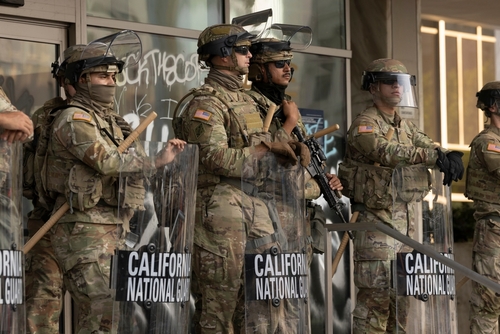
Nearly $600 million in taxpayer money has already been burned on federalized National Guard deployments to major U.S. cities—and the bill could top $1 billion this year if Washington keeps the tap open.
CBO puts a hard number on a fast-growing domestic mission
The Congressional Budget Office released a cost estimate for federally deployed National Guard missions ordered into U.S. cities during 2025, placing the total at roughly $589 million through December. CBO’s accounting also highlighted a narrower total—$496 million—attributed to specific city operations, excluding a New Orleans deployment. The agency emphasized uncertainty, warning that legal challenges, mission changes, and duration could swing costs sharply in either direction.
CBO’s estimates show why costs can surge quickly once Guard troops move into federal service. The analysis used Pentagon metrics that bundle pay, benefits, lodging, food, and transportation, with totals in the range of roughly $522 to $607 per soldier per day in some cases. CBO also estimated the marginal monthly cost of adding forces, putting the increase at roughly $18 million to $21 million per month for each additional 1,000 soldiers.
The Trump administration’s deployment of federal troops to six U.S. cities has cost taxpayers roughly $496 million through the end of December, and continued deployment could cost over $1 billion for the rest of the year, according to new data.https://t.co/8xBCqg1Pxp
— Chicago Tribune (@chicagotribune) January 29, 2026
Where the deployments happened, and what ended versus continued
The timeline centers on a June 7, 2025, presidential memorandum calling at least 2,000 National Guard troops into federal service, followed by a large Los Angeles deployment that included roughly 4,200 Guard members and about 700 Marines. Later deployments followed in Washington, D.C., Memphis, Portland, and Chicago. By early 2026, reporting indicated Los Angeles, Portland, and Chicago missions had ended, while D.C. and Memphis continued.
CBO’s city-by-city cost details show how quickly a single metro area can dominate spending. Stars and Stripes reported the 2025 tab at about $193 million for Los Angeles and $223 million for Washington, D.C., with Memphis at $33 million, Portland at $26 million, and Chicago at $21 million. Reporting also noted a continuing Texas standby mission involving about 200 troops. New Orleans was described separately as a state-capacity deployment rather than the same type of federal activation.
Why D.C. is the budget driver—and why the estimate could spike in 2026
Washington, D.C., stands out as the center of gravity for both politics and spending. Reporting described about 2,690 Guard members continuing in D.C., with CBO projecting costs that could run about $55 million per month there alone, depending on troop levels and support requirements. One cited projection put the broader 2026 price tag at about $1.1 billion if deployments continue at end-of-2025 intensity, with D.C. making up the largest share.
CBO also stressed that forecasts are “highly uncertain” because they depend on how long troops stay, whether deployments expand, and how courts respond to legal disputes. Early January 2026 reporting referenced withdrawals and halts tied to legal developments, including actions connected to California, Oregon, and Illinois. For taxpayers, that uncertainty matters because domestic deployments can become an open-ended line item, rising or falling faster than Congress can practically debate it.
Oversight and constitutional friction collide with public safety demands
Sen. Jeff Merkley of Oregon and other Democrats requested the CBO review, framing the deployments as wasteful and demanding more transparency about the running costs. Supporters of the deployments argue the federal government has a duty to protect federal personnel and property, especially when protests or disorder threaten public safety. The research provided does not quantify crime reduction or deterrence outcomes, so the effectiveness debate remains largely political rather than data-driven.
For conservatives, the core issue is twofold: maintain law and order while guarding against mission creep and federal overreach. Federalizing Guard units under Title 10 can bypass governors and intensify separation-of-powers tension, especially when deployments land in Democrat-led cities that resist Washington’s approach. CBO’s numbers do not judge the policy, but they do underscore a reality voters understand: once “temporary” operations become routine, costs and authority expand together.
With deployments continuing in D.C. through 2026 and other missions still active or on standby, the financial and constitutional questions will stay on the table. CBO’s estimate provides a baseline that neither party can ignore: about $93 million per month at late-2025 levels, with meaningful increases for every additional 1,000 troops. If policymakers want to reassure taxpayers, the next step is clear benchmarks—duration, scope, and legal authority—so “protecting federal interests” does not become a blank check.
Sources:
https://www.cbo.gov/publication/61943
https://www.stripes.com/theaters/us/2026-01-28/cbo-estimate-national-guard-deployments-20555864.html
https://www.cbo.gov/system/files/2026-01/61943-Troop-Deployments.pdf