
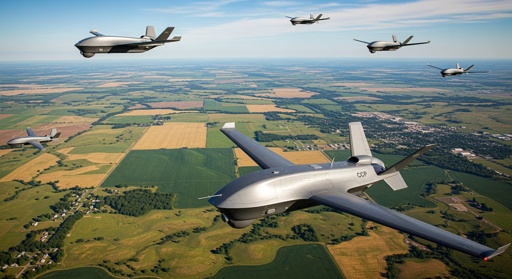
Over 350 unauthorized drone incursions violated US military airspace in 2024 alone, exposing critical vulnerabilities at strategic installations while bureaucratic red tape hamstrings commanders from defending our bases against potential foreign reconnaissance.
Escalating Threat to Strategic Installations
Unauthorized drones penetrated US military airspace over 350 times across more than 100 facilities in 2024, representing an alarming escalation in security breaches at strategic installations. The incursions increased 82% from the previous year’s 230 incidents to 420 violations, creating an average of one to two breaches daily at Department of Defense sites. These weren’t isolated hobbyist mistakes—multiple waves targeted bases like Wright-Patterson AFB in Ohio, forcing airspace closures, and Marine Corps installations in California suffered six consecutive days of violations in December 2024.
The pattern extends beyond American soil, with similar drone swarms appearing over RAF bases hosting US forces in the United Kingdom and Ramstein Air Base in Germany during late 2024. Navy Rear Admiral Paul Spedero Jr. warned bluntly that US forces are “not prepared for adversary reconnaissance and attacks,” a chilling assessment given that drone attacks already killed three American soldiers at a base in Jordan in January 2024. These coordinated incursions demonstrate capabilities far exceeding random civilian flights, raising legitimate concerns about foreign surveillance operations probing our defenses for weaknesses.
Regulatory Chains Binding Military Response
Federal Aviation Administration and Department of Justice regulations severely limit military commanders’ ability to neutralize drone threats, requiring proof of “hostile intent” before authorizing shoot-downs. This bureaucratic straitjacket forces base commanders to watch potential surveillance drones operate freely over sensitive facilities, unable to act until threats become imminent dangers to life or critical assets. General Guillot of NORTHCOM acknowledged that while most incursions involve hobbyists, the legal framework creates dangerous gaps that adversaries can exploit, particularly as AI-enabled autonomous drones proliferate with capabilities that exponentially amplify reconnaissance and attack potential.
The regulatory paralysis mirrors broader government overreach problems where well-intentioned rules prevent common-sense security measures. Installation commanders possess kinetic countermeasures but cannot deploy them without navigating layers of federal approval, delaying responses while unidentified aircraft circle overhead. This absurd situation leaves our military hamstrung by the very government agencies supposed to support national defense. The Pentagon has submitted legislative proposals to expand lethal force authorities, recognizing that current restrictions favor potential adversaries conducting reconnaissance operations with minimal risk of interdiction.
Congressional Pressure for Accountability
House Republicans on the Military and Foreign Affairs Subcommittee demanded documents from the Department of Defense, Department of Transportation, and Department of Justice by July 2025, intensifying oversight after the spike in violations. Representative Timmons led the investigation into drone incursions, culminating in an April 2025 hearing titled “Securing the Skies” that examined gaps in detection systems and interagency coordination. Witnesses testified that AI-driven drone technology poses exponentially greater dangers than earlier models, with autonomous capabilities enabling sophisticated attacks like those observed in Ukraine, where truck-launched drones strike targets with devastating surprise.
The bipartisan push for National Defense Authorization Act amendments reflects rare agreement that current defenses fall short of emerging threats. Congress recognizes that commercial drone proliferation since the 2010s created vulnerabilities that adversaries now exploit, particularly as incidents like the December 2024 apprehension of a Chinese national operating drones near Vandenberg Space Force Base demonstrate foreign interest in our installations. The legislative response prioritizes centralized information sharing, budget increases for counter-drone systems, and expanded legal authorities that respect constitutional principles while enabling effective base defense against reconnaissance operations threatening national security.
Defense Improvements and Ongoing Vulnerabilities
Falcon Peak exercises conducted through October 2025 yielded improvements in drone detection, mitigation capabilities, and budget allocations for counter-unmanned aerial systems. NORTHCOM’s testing demonstrated progress in identifying and tracking small drones, addressing technological gaps that allowed earlier incursions to evade sensors designed for larger aircraft. These advances provide reason for measured optimism, though skeptics correctly note that bureaucratic and legal delays continue undermining operational readiness. The military’s technical capabilities increasingly outpace the legal frameworks governing their use, creating friction that adversaries can exploit during the critical seconds when base commanders must decide whether suspicious drones constitute actionable threats.
Despite improvements, investigations continue without confirmed links to foreign governments, though the absence of proof doesn’t eliminate legitimate security concerns. The DoD and FBI maintain that most sightings involve authorized flights or misidentified civilian aircraft, yet this assessment overlooks the documented cases involving sustained surveillance patterns and coordinated multi-day operations. The vulnerability parallels historical intelligence failures where agencies dismissed warning signs as routine until attacks materialized. Protecting American military installations requires proactive defenses rather than reactive investigations, demanding legal reforms that empower commanders to defend the bases and personnel under their command without waiting for bureaucratic permission while potential adversaries gather intelligence freely overhead.
Sources:
Drones flew into US bases 350 times in 2024. There are not enough countermeasures
Drone incursions at US military bases drive counter-UAS upgrades
Drone incursions at US bases come under intense scrutiny as devices prove lethality overseas
These wargames explored drone attacks on US military bases